Nung ako ay bata pa, madalas akong lumabas ng bahay na may dalang barya na matagal ko ring inawitan upang ibigay sa akin ng aking ina. May kakaibang hatid ang lamig na dulot ng mga barya sa aking kamay. Lamig na dumadaloy sa aking mga ugat at kalamnan at tila dinidiktahan ang aking buong katauhan na magtungo sa isang lugar. Lugar kung saan isa-isang susuyurin ng aking paningin ang mga nakasabit na plastik sa malamig na rehas na gawa sa bakal. Kapagdaka'y titigil ang pag-inog ng aking daigdig sa hatid na kaligayahan ng mga bagay na aking namamasdan. Kaligayahang dagling mapapawi dahil kailangan kong gumawa ng isang malaking desisyon - ang mamili sa pagitan ng Pompoms at Wonder Boy. Ganun kaespesyal ang mga sitsiryang aking nakagisnan. Kung kaya't magpasahanggang ngayon, aking itong hinahanap hanap at inaasam asam! Muli nating balikan ang nakaraang dalawampu't higit pang taon at sariwain ang mga sitsirya ng dekada otsenta! 1. Pompoms - Ang all time favorite. Halos araw araw, ito na ang nakagisnan ng aking bituka na meryenda sa umaga, sa hapon at sa gabi! Ito ang pangunahing salarin kung bakit laging kulay orange ang aking daliri. Madalas pa nga, makunat na ang nabibili ko sa tindahan pero okay lang, solb pa rin!
2. Wonder Boy - Hindi ko alam kung saan sya gawa pero nasa kanya na ang lahat ng aking hinahanap hanap - malutong, maalat at meron syang mamula-mulang pulbos na maalat pa rin.
3. Haw Flakes - Ito ang opisyal na ostiya ng aking kabataan. Madalas, ako ang gumaganap na pari at sinusubuan ko ang aking mga kalaro na tila ba mga nangungumunyon. Maasim asim, maalat alat, manamis namis!
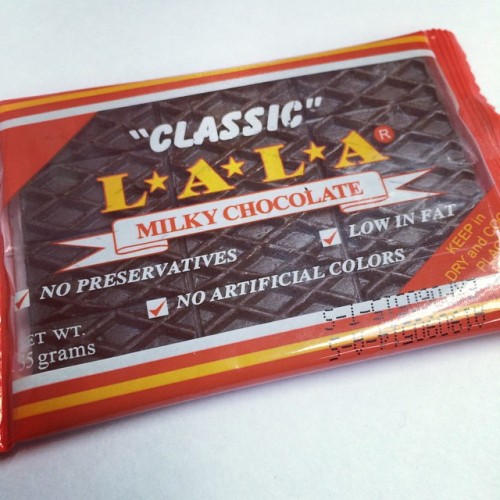
4. La La - Hindi ito yung sitsiryang may malaking isda. Ito yung parang chocolate bar na pinipilit na maging chocolate bar. Bagamat hindi ito ang aking ideya ng chocolate bar, may kakaibang ligaya ang hatid nito sa aking murang panlasa.
5. Pritos Ring - Barbeque-flavored snack - medyo maanghang, maalat at manamis namis. At syempre, hindi ito basta basta sinusubo lang. Una, ilalagay mo ito sa iyong mga daliri na tila sa isang sing sing at saka mo sya isa isang kakainin! Finger-lickin' good!
6. Pewee - Halos kalasa lang ito ng Pritos Ring, kaso di masyadong nakaka-excite kase isususbo mo lang sya.
7. Cheeze-It - Kapamilya ito ng Pewee (gawang Nutri Snack). Kagaya ng Pompoms, ito ang pangalawang salarin kung bakit nagkukulay orange ang aking mga daliri. Cheese flavor daw sya pero parang hindi naman pero masarap pa rin.
8. Kending Hubad - Dito ko unang naramdaman ang kapangyarihan ng pera! Singko sentimos lang kase ang isa nito. Para lang syang asukal na tumigas at kinulayan ng water color.
9. Bazooka - Ito yung kulay pink na bubble gum na may comics ang wrapper. Enjoy akong nguya nguyain ito nung bata ako kahit na masakit sa panga.
10. Frostee - Ito ang ice candy ng mayaman. Hindi kase to gawa sa bahay - gawang pabrika. Matigas ang plastik at iba-iba nag kulay. Ang ultimate pampalamig sa tag-init ng batang paslit!
Sharing one of my favorite pork dish. I like the beef version as well but it takes a lot longer to cook.
Happy munching!
Ingredients: 1 kg pork rib 5 large garlic cloves, crushed and chopped 1 large onion, finely chopped 4 cups water 1 cup red bell pepper, cut into strips 3 packs Hunt's 115g tomato sauce 2 cans Reno liver spread 1 teaspoon, crushed chili (siling labuyo) 2 cups potatoes, sliced 2 cups carrots, sliced 1 cup cooking oil 1/2 cup stuffed green olives 1 tablespoon Magnolia Cheezee pimiento 1 pack Eden Cook Sarap grated cheese salt and pepper
Procedure: 1. Heat the cooking oil in the pan and fry the carrots and potatoes until color turns light brown.
2. Remove the fried carrots and potatoes from the pan and set aside.
3. In the same pan where the vegetables were fried, sauté the garlic and onions.
4. Add the pork rib and simmer for 5 minutes.
5. Add water and let the pork boil until tender.
6. Add the tomato sauce and liver spread and simmer for 10 minutes.
7. Add green olives, some of the carrots, Magnolia Cheezee Pimiento, bell pepper,crushed chili,and some of the potatoes and simmer for 5 to 10 minutes.
8. Add salt and pepper to taste.
9. Serve hot. Top with fried potatoes, red pepper strips and grated cheese.
Note: This was originally posted in my Friendster account when I was still an agent (January 12, 2008). Then re-posted on Marlon Quintos' Official Literary Site on February 14, 2010 and my Facebook account on February 17, 2010.
Limandaan walumpu't anim na libo at walumpung minuto. Pilit kong binaliktad ang aking buhay - tulog habang tirik ang araw, kumakayod habang madilim ang mga lansangan. Minsan na lang masinagan ng araw ang namumutla kong mukha. Akmang akma raw sa pangarap ng karamihang pinoy na pumusyaw ang balat gaya ng mga banyagang Kanluranin. Kadalasan may bahid ng pagtatanong at malisya ang tingin sa akin ng aking kapitbahay na si Aling Cering sapagkat pumapasok ako sa trabaho pagkagat ng dilim. Hindi ko siya masisisi. Marahil ay di pa niya batid kung anong buhay mayroon ako - buhay na salungat sa buhay ng karamihan. Marahil ay di niya pa batid na araw araw ako ay naglalakbay patungo sa malamig na lugar upang makipagtagisan ng dila gamit ang wikang banyaga naman sa akin. Hindi madali ang pagtahak ko sa buhay call center. Nang ibinalita ko ito sa aking mga kaibigan, isang mataginting na "no!!!" ang aking narinig. Sa aking pakiwari ay kasabay ng pagtutol na ito ang mga tambol at pompyang ng sandaang banda. Sa kanila, kasing kahulugan ng call center and isang sumpa. Mawawalan daw ako ng social life. Mahihirapan daw ang patpatin kong katawan sa mga pagbabago ng aking sistema. Hindi raw ako makakatulog ng sapat dahil mahirap matulog habang tirik ang araw. Malilipasan ng gutom dahil mas nanaisin ko pa raw ang matulog na lang kaysa kumain. Dahil dito, ako ay magkakasakit, manghihina at sa paglaon ay mawawalan din ng hanapbuhay. Masaklap na buhay - ito ang pilit nilang iginigiit. Ngunit iba ang takbo ng aking isip. Itinuloy ko ang dikta ng aking utak. Call center ang sagot sa minimithi kong mas malaking sweldo. Hamak na mas malaki ang kikitain ko dito kaysa sa dati kong trabaho. At kung papalarin, halos doble ang kikitain ko kumpara sa dati kong sweldo kung maiuuwi ko ang buwanang attendance bonus. Ang mga unang araw ko sa call center ay di ganoon kadali. Sinikap kung ituwid and aking likod habang nakasandal sa upuang umiikot, kahit na nais na nitong humimlay sa malambot na higaan. Kusa mang pumipikit, pinilit kong imulat ang aking mga mata. Kulang na lang ay tukuran ko ang mga talukap nito upang hindi magsara. At pagkatapos ng trabaho, tila may sariling isip ang mga paa ko habang binabagtas nito ang lugar na aking tutulugan, at doon ay nag-uunahang lumapat sa kutson ang aking ulo, batok, likuran, hita at binti. Hindi rin magkamayaw sa pagpikit ang mga matang matagal nang naghihimagsik. Kapagdaka ay puputulin ng mainit na araw ang ginhawang dulot ng malambot na kutson. Pagsapit ng tanghali, ginigising ako ng init nitong tumatagos sa bubong at kisameng gawa sa hardiflex, tila ba kinukutya ng araw ang kapangyarihan ng aking bentilador. Ito na marahil ang umpisa ng sumpang tinutukoy nila. Lumipas ang mga araw, mga araw na naging linggo, mga linggong naging buwan, at mga buwang naging taon. Ang bilis ng panahon. Di ko namamalayang bahagi na pala ng aking sistema ang sumpa ng mga unang araw ko sa call center - sumpang may hatid namang biyaya. Hindi lamang dahil doble ang kinikita ko kaysa sa kaibigan kong ilang taon na ring accountant sa isang sangay ng gobyerno. Higit pa doon. Dahil sa call center, naging rest day ang tawag ko sa day off. Ang lunch naman ay pwede nang kainin sa hatinggabi o kaya sa madaling araw. Ewan ko kung positibo ito o hindi. Ang alam ko ay lumalawak aking bokabularyo. Tumatas din ang aking dila sa pagsasalita ng wikang Ingles. Kasindulas ng palos ang bigkas ko sa mga katagang "twenty", "thirty" at "forty." Kung dati ay may tunog "t" sa mga salitang nabanggit, ngayon tila milagrong naglaho ito - naging "twenny" "thirry" and "forry" na lamang. At kung dati ay "Hello" lang alam kong pambati tuwing sumasagot ng telepono, ngayon ay marami na akong alternatibo gaya ng "Thank you for calling, my name is..." at "Hi, my name is Genie, your wish is my command." Sabi ng iba, nakakabobo daw ang pagiging call center agent. Taliwas ito sa aking naging karanasan. Ang hilig ko sa math ay naipamalas ko sa pag-aanalisa at pagkwenta ng mga bills ng customer. Gumagana rin and hilig ko sa paggawa ng kwento habang pilit kong ipanagtatagni-tagni ang mga pangyayari ayon na rin sa kwento ng customer at sa mga masasalimuot na notes sa kanilang account. Pinangarap ko rin dating maging psychologist at sa call center ko ito naisakatuparan - habang pilit na pinapakalma ang mga nagwawalang customer. Ngunit hindi lamang paglinang sa mga kakayahang ito ang dulot ng call center sa akin. Higit pa sa mga ito ay ang mga taong araw araw kong nakakasalamuha. Ilang pangalan na ba ang naglabas masok sa aking isip? Ilang mukha na ba ang nakasanayan ng titigan ng aking mga mata? Ilan amoy na ba na sa tuwing natatanto ng aking ilong ay may pangalan ng kaakibat? Dito ko natagpuan ang lahat ng klase ng tao - mga taong kamumuhian at hahangaan, kagigiliwan at kaiinisan, malinis at marumi, malaki at maliit, maputi at maitim, malaki ang mata at singkit, sarat ang ilong at matangos, mabango at mabaho - iba't ibang anyo, iba't ibang kulay, iba't ibang paraan ng pakikisalamuha. Karamihan sa kanila'y nananatiling mga estranghero. Ang iba naman ay naging kakilala. At ang ilan ay naging kaibigan. Ngunit silang lahat ay bahagi na ng aking pagkatao. Ng aking buhay. Limandaan walumpu't anim na libo at walumpung minuto. At patuloy pang nadaragdagan
The Vigan Heritage Village is listed as a World Heritage Site by UNESCO, because of its famous Hispanic houses and well-preserved Spanish colonial town, and is well-known for its cobblestone streets, and a unique architecture that fuses Philippine building design, and construction with colonial European architecture.
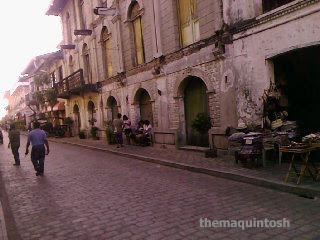
This is the preserved tourist attraction of Vigan, Ilocos Sur . This is the only place in Vigan where the cobblestone street have been preserved and the houses/buildings retained their relic-like appearances .
Only calesas (a horse driven carriage, transportation used during Spanish era) are allowed to pass through this street. It is a short stretch that people are encouraged to walk and enjoy exploring the souvenir stores, eating the famous Vigan Empanada or Vigan Longganisa!
The view from the Cordillera Inn.
Another view of the Calle Crisologo.
Calle Crisologo at night.
Trees are adorned with colorful lantern at Plaza Maestro.
Souvenir shops lined the side street of Caller Crisilogo
Kalesa (horse driven carriage) in front of Cordillera Inn.
Wooden souvenirs and antiques at Calle Crisologo.
Signage of one of the souvenir shops along Calle Crisologo.
The City of Vigan (Ilokano: Ciudad ti Bigan; Tagalog: Vīgân; is a 5th class city in the province of Ilocos Sur, Philippines. It is the capital of the Province of Ilocos Sur. The city is located on the western coast of the large island of Luzon, facing the South China Sea.
It is a World Heritage Site in that it is one of the few Hispanic towns left in the Philippines, and is well known for its cobblestone streets, and a unique architecture that fuses Philippine and Oriental building designs and construction, with colonial European architecture.
According to the latest Philippines census, it has a population of 47,246 people in 9,193 households. Former Philippine president Elpidio Quirino, the sixth president of the Philippines, was born in Vigan, at the current location of the Provincial Jail (his father was a warden); and resided in the Syquia Mansion.
The area of Vigan was originally a settlement of traders coming from the Fujian Province, China. At the time of Spanish colonisation, the Chinese settlers, whose language was Southern Fujianese (Min Nan, often referred to as "Hokkien" by most Filipinos), referred to the area as "Bee Gan" (Chinese: 美岸; pinyin: Měi'àn), which means "Beautiful Shore." Since the Castillian and Basque Spanish conquistadors interchanged V and the B to refer to the B sound, they spelled the Hokkien Chinese name "Bee Gan" as "Vigan", which is the name used to this day. Vigan's Chinese heritage is still evident from the numerous elite Chinese creole families who come from the area, many of whom adopted Hispanic family names. Others, such as the Sy-Quia family, have retained Chinese-derived surnames, though most, if not all, of the Christian Chinese creole families fully Hispanicised themselves culturally.
The most commonly known source of the city's name is from the Biga'a plant, which once grew abundantly along the banks of the Meztiso River, from which captain Juan de Salcedo derived the city's name (after a misunderstanding with the locals, thinking he was asking the name of the plants).
The area of Vigan was originally a settlement of traders coming from the Fujian Province, China. At the time of Spanish colonisation, the Chinese settlers, whose language was Southern Fujianese (Min Nan, often referred to as "Hokkien" by most Filipinos), referred to the area as "Bee Gan" (Chinese: 美岸; pinyin: Měi'àn), which means "Beautiful Shore." Since the Castillian and Basque Spanish conquistadors interchanged V and the B to refer to the B sound, they spelled the Hokkien Chinese name "Bee Gan" as "Vigan", which is the name used to this day.
Vigan's Chinese heritage is still evident from the numerous elite Chinese creole families who come from the area, many of whom adopted Hispanic family names. Others, such as the Sy-Quia family, have retained Chinese-derived surnames, though most, if not all, of the Christian Chinese creole families fully Hispanicised themselves culturally.
The most commonly known source of the city's name is from the Biga'a plant, which once grew abundantly along the banks of the Meztiso River, from which captain Juan de Salcedo derived the city's name (after a misunderstanding with the locals, thinking he was asking the name of the plants).
Vigan is an island which is separated from the mainland by three bodies of water: the Abra River, the Mestizo River, and the Govantes River. The city is unique in the Philippines because it is one of many extensive surviving Philippine historic cities, dating back to the 16th century.
Vigan was a coastal trading post long before the Spaniards arrived; Chinese traders sailing from the South China Sea came to Isla de Vigan (Island of Vigan) via the Mestizo River that surrounded the island. On board their ships were seafaring merchants that came to trade goods from other Asian kingdoms in exchange for gold, beeswax, and other mountain products brought by the indigenous peoples from the Cordilleras region.
In the book The Philippine Island (Vol. III, p. 276, Blair and Robertson) two letters from Governor General Guido de Lavezaris to King Philip II of Spain mention: "It seemed best to send Captain Juan de Salcedo with 70 or 80 soldiers to explore the coast of Los Ilocanos on the shores of the river called Bigan." The Spaniards marched north from Manila on May 20, 1572, and arrived in Vigan on June 12, 1572.
Thus, after the successful expedition and the exploration of the North, Juan de Salcedo founded "Villa Fernandina de Vigan" in honor of King Philip II’s son, Prince Ferdinand, who died at the age of four. From Vigan, Salcedo rounded the tip of Luzón and proceeded to pacify Camarines, Albay, and Catanduanes.
As a reward for his services to the King of Spain, Salcedo was awarded the old province of Ilocos, which consisted of the modern provinces of Ilocos Norte, Ilocos Sur, Abra, La Unión and part of Mountain Province as his hacienda (estate), and was accorded the title of "Justicia Mayor de esta Provincia de Ylocos" (Province Mayor of Ilocos).
In 1576, Salcedo returned to the capital of his encomienda (trusteeship), Vigan, bringing with him his soldiers, and some Augustinian missionaries to pioneer the evangelization of the Ilocos region. He established a Spanish city for the purpose of controlling the neighboring country.
Governor General Gómez Pérez Dasmariñas, in his Account of encomienda dated in Manila on May 31, 1591, states: "The town of Vigan called Villa Fernandina consisted of Spanish settlers; a priest; a Justice Alcalde Mayor (Governor); and a Deputy. The King collects 800 tributes (equivalent to 3,200 subjects)." During this period, Vigan was composed of 19 barrios (districts).
Between 1645 to 1660, Vigan was divided into 21 "Cabezas de Barrio" (Town Mayors) as mentioned in the Libro de Casamiento (Book of Marriage); from the records of the parish house of Vigan found in its Archives. Separated from the indigenous population, the Chinese migrants were residents in a neighbourhood called El Pariancillo, los Sangleyes del parian (The Sangleyes of the Parian); and the Spanish settlers were residents in a town called Los Españoles de la Villa (The Town´ Spaniards).
During the Philippine Revolution of 1896 to 1898, Philippine Revolutionary forces, supported by the Ilocano rebels, attacked and defeated the Spanish Colonial forces and captured the city in the Siege of Vigan. Starting from the Philippine-American War from 1899 to 1901, American Colonial troops occupied the city. Forces led by Col. James Parker occupied the Cathedral.
During World War II, Japanese Imperial Army planes bombed Vigan on December 1941 and Japanese troops occupied the town in 1942. In 1945, combined U.S. and Philippine Commonwealth ground troops, aided by Ilocano resistance fighters, defeated the Japanese Imperial forces and liberated Vigan.
The Movie by Bonda Fajardo "ILIW", 2010 [1]: Colonel Takahashi & Fr. Joseph Klecamf protected "VIGAN" neither to be burned by Japanese Army nor attacked by US Army.
2007 Vigan City was listed by UNESCO as the best preserved example of Spanish colonial towns in Asia. Its architecture is the conglomeration of cultural elements from the Philippines, China, and Spain, making it unique to the rest of the world.
The Experience
I lived in Caoayan, a coastal town that used to be a barangay of Vigan, for almost six years. This is where I spent my last two years of grade school and my entire high school life. Locals from nearby towns including Vigan usually visit this place for a taste of grilled delicacies. Caoayan is also famous for its hand-wooven textiles or abel Iloco.
The New Caoayan Town Hall and the Caoayan Bridge.
One of the main attractions of Vigan is Baluarte. It is a 10-minute drive from the city proper and is very near to Caoayan's poblacion or town proper. Baluarte is 80 hectares of gently rolling terrains, hills and mountain sides, the structures of facilities and amenities, its phases of construction is in its best possible realistic and natural habitat for good and sound animal care.
Zoo patrons are given free admission and free use of its facilities in the picnic areas. It is open daily from 7am to 6pm. You are free to bring your food and be at the picnic place of your choice. We have enough comfort rooms available at the entrance. Baluarte staff can accommodate educational tours, please feel free to contact us via email on this website or call 6377-722-7186.
Ostrich at Baluarte in Vigan, Ilocos Sur
A small lagoon with gold fish at Baluarte in Vigan, Ilocos Sur
Tiger at Baluarte in Vigan, Ilocos Sur
Camel at Baluarte in Vigan, Ilocos Sur
This greets the visitors when entering Baluarte in Vigan, Ilocos Sur